Table of Contents
Scope
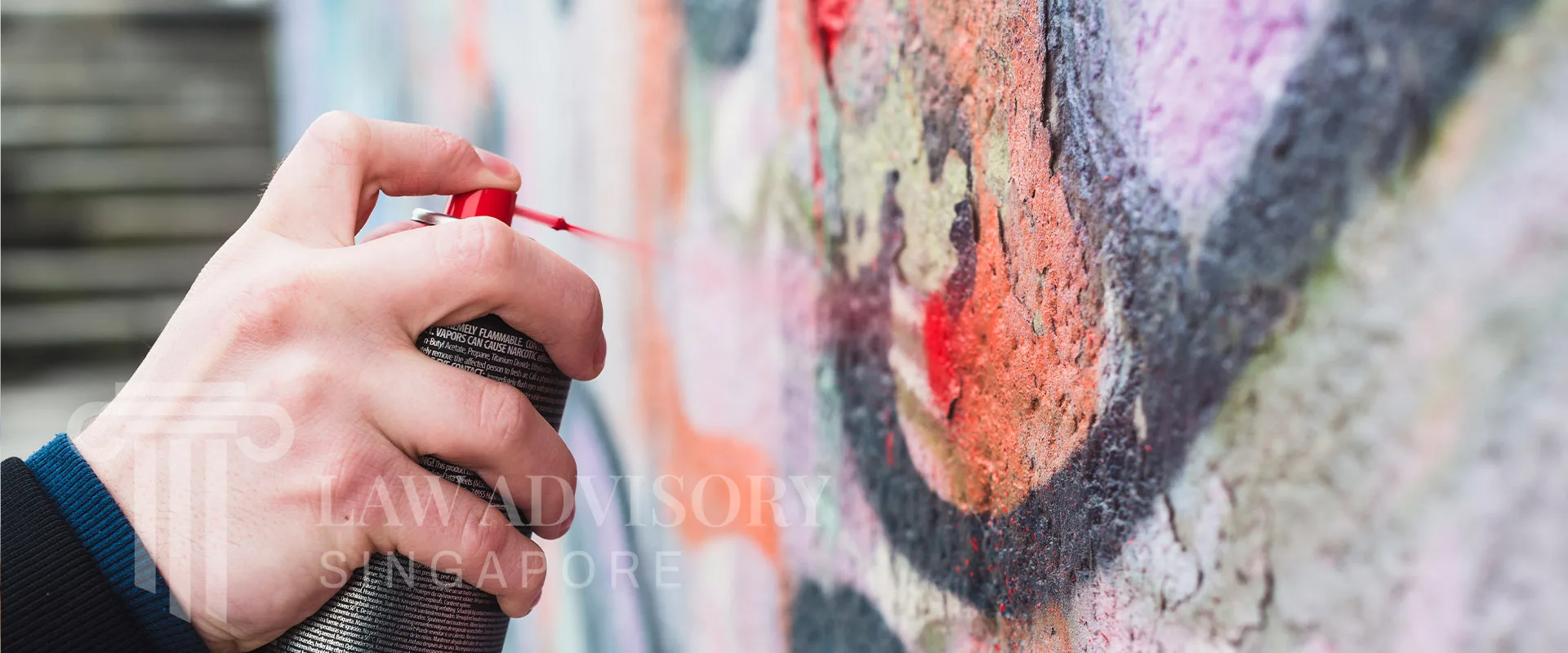
As a true “concrete city”, Singapore is internationally recognized for its spotless streets and clean walls. This reputation is not accidental but the result of deliberate public policy and the nation’s strict laws on vandalism. Central to this framework is the Vandalism Act 1966 (2020 Rev Ed) (the “Act”), which defines an “act of vandalism” in section 2 and covers, for example, writing or affixing material to public or private property without the required written authority or consent.
This article provides an overview of Singapore’s law on vandalism. It will explore how the offence may be committed under the law, examine some existing cases of persons convicted of vandalism, and outline the penalties imposed on offenders.
Executive Summary of Vandalism in Singapore
In Singapore, vandalism is a criminal offence governed by the Act. Individuals convicted of vandalism will face strict penalties such as fines, imprisonment, or even caning in the case of repeated offenders.
What Is the Law on Vandalism?
The Act adopts a broad definition of “vandalism”. In particular, section 2(a) of the Act provides that vandalism occurs when a person, in the case of public property (i.e., property belonging to the Government – bus stops, drains, military equipment) without the written authority of an authorized officer or representative of the Government; or in the case of private property, without the written consent of the property owner or occupier, intentionally does any of the following acts:
- Writes, draws, paints, marks, or inscribes on any public property or private property any word, slogan, caricature, drawing, mark, symbol or other thing;
- Affixes, posts up or displays on any public property or private property any poster, placard, advertisement, bill, notice, paper or other document; or
- Hangs, suspends, hoists, affixes or displays on or from any public property or private property any flag, bunting, standard, banner or the like with any word, slogan, caricature, drawing, mark, symbol or other thing.
Additionally, section 2(b) of the Act separately captures the more serious conduct of stealing, destroying or damaging public property. That limb is treated more severely for the purpose of sentencing scheme in section 3 of the Act.
What is the Purpose of Vandalism Law?
At a practical level, anti-vandalism laws help to preserve the cleanliness of Singapore and prevent damage to public property, ensuring that they remain safe for and usable by all citizens, by deterring acts of vandalism.
Historically, however, the introduction of the Act in 1966 was motivated by the socio-political climate of the time. At the time, vandalism was not merely a nuisance but a vehicle for spreading anti-social or anti-national messages, The government therefore introduced this Act in an effort to preserve national unity in Singapore.
What Are Some Examples of Vandalism Law Applied in Real Life?
Ng Chye Huay v Public Prosecutor [2017] 5 SLR 961M
The accused displayed placards and hung banners containing messages about Falun Gong and its practitioners on public property. She argued, amongst others, that her conduct did not amount to vandalism because the banners and placards did not cause any damage to the property, and as she had removed them personally without assistance from any public authority.
The Court rejected the defence that that some degree of damage or permanent alteration is required: the High Court held that the statutory definition covers display or hanging of banners and placards without authority, and that liability does not depend on there having been any permanent damage.Finally, while the ease of restoring the property might be considered during sentencing, it does not negate liability.
Fay Michael Peter v Public Prosecutor [1994] 1 SLR(R) 1063
The accused was convicted twice under section 3 of the Act as he sprayed red paint on two motor vehicles. He was sentenced to 2 months’ imprisonment and 3 strokes of the cane for each charge. This case attracted significant attention because the sentence imposed included both imprisonment and judicial caning.
Public Prosecutor v Ganesh S/O Cumaran [2025] SGDC 164
The accused was convicted twice under section 3 of the Act for (1) splashing paint and leaving a debtor note at a HDB unit; and (2) splashing paint on an electrical room door and floor next to the HDB unit.
What Are Practical Steps to Take to Avoid Liability under Vandalism Law?
Obtaining Written Permission
If there is uncertainty as to whether a particular act may constitute vandalism under the Act, it would be prudent to obtain written permission from the property owner or the relevant authority before proceeding.
Persons Authorized to Draw on Property
Section 4 of the Act provides that any member of the Singapore Police Force may demand for the written authority or written consent mentioned in section III. Failure to produce such proof on demand constitutes an offence and will result in a fine of up to $500 if convicted. Under section 5, the officer would also have the authority to seize any item used for vandalism if they reasonably believe that an act of vandalism was committed.
Accordingly, individuals who are legitimately authorized to draw, paint, or display advertisements on property should always retain a copy of the written authority or consent whilst engaging in such work and should be ready to produce it upon request.
How is Vandalism Law Enforced?
According to section 3 of the Vandalism Act 1966, it is an offence for any person to commit, attempt, or cause any act of vandalism. Notably, the idea of “cause” extends liability for vandalism beyond direct perpetrators to those who instruct, encourage, or direct others to carry out acts of vandalism.
If convicted, the offender will face a fine not exceeding $2,000 or imprisonment for a term not exceeding 3 years. Repeated offenders may also be punished with caning – not less than 3 strokes and not more than 8 strokes. The court added that the ease of restoration (or absence of permanent damage) may be relevant in mitigation at sentencing but does not negate criminal liability under the Act.
What Are Some Key Takeaways?
The Vandalism Act 1966 establishes a broad and strict framework for addressing vandalism in Singapore, reflecting the state’s priority of maintaining public order and cleanliness. Offenders may face severe penalties including fines, imprisonment or even caning. To avoid liability then, one should always obtain written permission from the property owner or relevant authority before undertaking any work in relation to the property.
Disclaimer
This article is intended for general informational purposes only and does not constitute legal advice. While every effort has been made to ensure the accuracy and relevance of the information provided, readers are encouraged to consult a qualified legal professional for advice tailored to their specific circumstances. The content reflects the legal position in Singapore as of the time of writing and may be subject to changes in legislation or legal interpretation.