
Disputes over small sums can feel frustrating and time-consuming, especially when the cost of taking legal action ends up outweighing the value of the claim itself. Fortunately, Singapore’s Small Claims Tribunals (“SCT”) administered as part of the State Courts offers an accessible, affordable, and efficient way for individuals and businesses to resolve such disputes.
Compared to traditional litigation in the State Courts (Magistrates’ and District Courts) or High Courts, the SCT offers parties a quicker, simpler and less expensive process for resolving disputes over lower-value claims. Some of its comparative advantages are as follows:-
- (a) Compared to civil litigation, which generally may last around 18 months, most SCT claims conclude within 4 months of filing.
- (b) Proceedings before the SCT are also more informal – notably, parties may not be represented by lawyers in proceedings before the SCT.
- As such, parties claiming through the SCT generally incur lower costs, due to the shorter duration of proceedings and the lack of legal fees.
Given these benefits, the SCT has become a preferred forum for resolving smaller disputes. In fact, in 2022 alone, 9,113 claims were filed in the SCT – making up around 75% of all cases handled by the Community Justice and Tribunals cluster.
This article will guide readers through the process of resolving a dispute in the SCT, from filing and responding to a claim, to the ways a dispute may be resolved in the SCT, and the available options for enforcement or appeal from the SCT.
Table of Contents
What Are The Key Definitions In Small Claims Tribunal (SCT)?
Before delving into the procedural details, it is important to first understand the key terms commonly used in SCT proceedings:-
- (a) Parties: The “Claimant” is the party who initiates the claim by lodging it with the SCT, while the “Respondent” is the party against whom the claim is brought.
- (b) Cause of Action: Claims in the SCT must have an underlying “cause of action”, which is a set of facts which entitle the Claimant to start a claim in the SCT against the Respondent. For example, a shopkeeper who does not get paid after delivering goods to a customer may have a cause of action to claim the price for the unpaid goods.
- (c)Tribunal Magistrate and Registrar: The “Tribunal Magistrate” presides over SCT hearings and decides the outcome of claims. The “Registrar”, which includes the Registrar, Deputy Registrar, or Assistant Registrars of the SCT, is responsible for managing the case process and handling preliminary matters.
What Are The Key Steps In Making An SCT Claim?
Should you, as the Claimant, choose the SCT as the avenue for resolving your dispute with the Respondent, it is important to first consider the following matters when lodging your claim.
Step 1 – Determining the Eligibility of Claim
Only certain claims may be heard in the SCT. For a claim to qualify, the 6 conditions below must be met.
Here, a pre-filing assessment is also available on the Community Justice and Tribunals Systems (“CJTS”) to assist Claimants in determining if their claim can be brought before the SCT. More information regarding the pre-filing assessment and the CJTS if available at the following link: https://www.judiciary.gov.sg/services/cjts.
Condition 1: Date of Cause of Action
First, the SCT may only hear a claim within 2 years of the date of occurrence of its underlying cause of action. For example, if a contract was broken by the Respondent on 15 November 2023, the last day to file a claim would be on 15 November 2025. This two-year limitation applies following the legislative changes that extended the previous one-year period.
Condition 2: Location of Defendant
Second, the SCT can only hear claims that are served in Singapore. Thus, should the Respondent be located outside of Singapore, the claim may not be brought before the SCT.
Condition 3: Whether Parties are Bankrupt or Insolvent
Third, both the Claimant and the Respondent should not be insolvent or bankrupt. The SCT will not ordinarily allow proceedings to continue where a party is bankrupt, insolvent or in liquidation unless the necessary consents or leave are obtained. Having said that, in practice:
- If either the Claimant or the Respondent is bankrupt or insolvent, the Claimant cannot commence a claim unless they have gotten permission from the Official Assignee. Here, the Official Assignee is a public servant who acts as the receiver of the bankrupt’s estate – they investigate the conduct and affairs of the bankrupt and recovers and realises his assets for distribution to the bankrupt’s creditors. (Note: from time to time private trustees administer bankrupt estates, but the Official Assignee retains oversight and certain consent functions.)
- If the Claimant is a corporate entity (i.e. a company registered with ACRA) that is in liquidation or winding up, it cannot start a claim unless it has permission from the Official Receiver or liquidator.
- If the Respondent is a corporate entity that is in liquidation or winding up, then the Claimant cannot proceed with a claim against them unless they have gotten permission from the High Court.
Condition 4: Accepted Cause of Action
Fourth, the SCT may only hear claims that are supported by certain accepted causes of action. The list below is exhaustive – if a claim does not fall within these categories, it cannot be brought before the SCT. For example, personal injury claims in tort are excluded and may not be brought before the SCT.
- Claims relating to a contract for the sale of goods (e.g. purchase of TV), or the provision of services (e.g. a contract to renovate a home). This also covers disputes against a seller of goods or supplier of services in consumer contracts for unfair practices. Briefly, it is considered “unfair practice” for a supplier or seller to mislead, lie to, or take advantage of a consumer. Additionally, specific instances of “unfair practice” may be found at the following link: https://sso.agc.gov.sg/act/cpfta2003?ProvIds=Sc2-#Sc2-.
- Tortious claims for damage caused to property, such as where damage is caused to the property of the Claimant by the carelessness, recklessness or improper acts of the Respondent. However, this does not cover situations where the damage to property is caused by a neighbour’s interference with the enjoyment of the property, or by a motor vehicle accident.
- Claims relating to a lease agreement over residential premises that does not exceed 2 years. This does not include (1) the lease of industrial or commercial premises, or (2) the license of any premises.
- Claims by an owner-developer for the recovery of any charge or interest under s 22(1) of the Building Maintenance and Strata Management Act (“BMSMA”). Under BMSMA s 22(1), if the purchaser of a lot fails to pay the maintenance charges for the development’s common property or limited common property within 28 days of receiving a written demand from the owner-developer, the outstanding charges, together with any interest, becomes a debt that is owed to the owner-developer.
- Claims by the management corporation for the recovery of any contribution or interest under s 40(6) of the BMSMA. Under BMSMA s 40(6), contributions levied by a management corporation are immediately due once imposed. If unpaid after 30 days, they accrue interest at a rate set by the management corporation, and both the outstanding contributions and interest may be recovered as a debt.
- Claims by the Housing and Development Board for the recovery of any improvement contribution, interest or penalty mentioned in s 83 of the Housing and Development Act (“HDBA”). Under HDBA s 83, any of the aforementioned sums payable to the Housing and Development Board may be recovered as debt by it.
- Claims by the Singapore Business Federation for the recovery of any subscription fees mentioned in s 12(4) of the Singapore Business Federation Act (“SBFA”). Under SBFA s 12(4), any subscription fees owed by members of the Singapore Business Federation may be recovered by its council as a debt.
- Claims by a Town Council for the recovery of any improvement contribution, interest or penalty mentioned in s 36 of Town Council Act (“TCA”). Under TCA s 36, any such sums may be recovered by a Town Council by an action for a debt.
- Claims by a Town Council for the recovery of any charge, fee, expense of penalty covered in s 73 of the TCA. Under TCA s 73, any of the aforesaid sums may similarly be recovered by a Town Council by an action for a debt.
Condition 5: Maximum Value of Claims in the SCT
Additionally, the SCT may only hear claims that fall within a certain monetary limit (the “Prescribed Limit”), and any claim that exceeds this limit cannot be brought before the SCT. Importantly, the value of a claim will be assessed as a whole, and a claimant cannot split one claim into separate proceedings simply to bring it within the SCT’s jurisdiction.
- Under normal circumstances, the Prescribed Limit of claims brought before the SCT cannot exceed S$20,000.
- Notwithstanding this, should the parties to the claim agree and sign a memorandum of consent, then the Prescribed Limit may be raised to S$30,000. The standard form for a memorandum of consent provided by the Singapore Courts may be found at this link: https://www.judiciary.gov.sg/docs/default-source/civil-docs/sct_memorandum_of_consent.docx.
- If a claim exceeds the Prescribed Limit of S$20,000 and the parties have not signed a memorandum of consent to raise it to S$30,000, the Claimant may still proceed by abandoning the amount in excess of S$20,000. However, if the Claimant opts for this, then any order made by the SCT in relation to their claim will be considered final, and the Claimant may not thereafter go after the excess amount initially abandoned.
Condition 6: No Concurrent Proceedings
Lastly, for a claim to be heard in the SCT, there must not be any concurrent proceedings in another court. This means that if a claimant has already started proceedings in the Magistrate’s Court, District Court, or High Court for the same claim, they cannot also bring it before the SCT. once a claim has been filed with the SCT, the claimant is barred from pursuing the same claim in another court.
Step 2 – Determining the Desired Outcome of Claim
Next, it is also important to understand the possible outcomes that may result from doing so. This helps Claimants assess whether the SCT is a suitable forum for resolving their dispute with the respondent, and whether it is likely to achieve the outcome they are seeking. Generally, the orders that the SCT may grant may be split into the 5 categories below, and the SCT may make any of the following orders as it thinks fit.- Orders for Payment of Money: Known as a “money order”, this is an order requiring a party to pay to another party a certain sum of money by a due date. This sum of money cannot exceed the Prescribed Limit of $20,000, or $30,000 if the parties had signed a memorandum of consent. If a money order is complied with, the party entitled to payment may begin enforcement proceedings.
- Orders relating to Provision of Goods and Services: Known as a “work order”, it requires a party to rectify defects in goods supplied, or make good deficiencies in services rendered. Such orders usually specify how the party must carry this out – for example, by replacing a defective item. The SCT may also set a deadline for compliance. If the deadline is missed, the work order will be converted into a money order. The SCT also has the power to amend or vary a work order it has previously issued. Where a work order is not complied with, the party in whose favour it was made may also commence enforcement proceeding.
- Orders relating to Leases and Tenancies: Known as an “order for vacant possession”, it may be made when a landlord successfully brings a claim against a tenant for unpaid rent. This order requires the tenant to vacate the property, and if the tenant fails to comply, the landlord may commence enforcement proceedings.
- Orders relating to Settlements: Known as a “consent order”, it may be issued where parties agree to settle the dispute at a eNegotiation, eMediation, consultation or hearing. The terms of the parties’ settlement agreement will be recorded as a consent order, and a copy of it will be issued to the parties through the CJTS. Should a party not comply with the consent order, the other party may begin enforcement proceedings.
- Other General Orders: These are orders that do not necessarily grant a party any relief, but may be considered more procedural or administrative in nature.
- Orders Dismissing a Claim: This involves the SCT dismissing a claim in its entirety, or in part. The effect of this is that all proceedings will stop, and the fees for filing that claim is not refundable. Such an order may be made where the SCT is of the opinion that a claim has no merit.
- Default Order: when one party fails to attend a scheduled consultation or hearing at the SCT. If the Claimant is absent, the claim will be dismissed. If the Respondent is absent, an order will instead be made in favour of the Claimant. The absent party, however, may apply to have the default order set aside within one month of its issue – a process explained later in this article.
- Discontinuance and Transfer Order: If the SCT decides that a claim does not fall within its jurisdiction, it may issue one of two orders. A “discontinuance order” ends the SCT proceedings entirely, with no refund of filing fees. This does not, however, prevent the Claimant from bringing the claim before another court. Alternatively, the SCT may issue a transfer order, which automatically transfers the claim to an appropriate court.
- Enforcement of Orders: At this point, it should be noted that all SCT orders are enforced as orders of the District Court. The process of enforcement will be explained later in this article.
Step 3 – Preparation of Supporting Information and Documents
As a final step before lodging a claim, the Claimant must also prepare all necessary information and documents required to support their claim.General Requirements – Individual Claiming Against Individual
Should both the Claimant and Respondent natural persons (i.e. individuals), the claim must contain the following key pieces of information and documents:- The name and address of each Claimant.
- The name and address of each Respondent.
- The sum of money claimed by each claimant.
- A summary of what is being claimed, and any other particulars of the claim that would be reasonably sufficient to inform the respondent of the grounds of the claim, as well as the manner in which the amount claimed was calculated. These may include the following items
- Contracts and other relevant documents that support the claim, such as invoices, receipts, letters, emails and messages. It should be noted that all documents must be provided in the English language.
- For disputes relating to a lease of residential premises, the Tenancy/Lease Agreement and Stamp Duty Certification.
- Any photograph, video recordings or audio recordings to support the claim (if applicable).
- Any photograph, video recordings or audio recordings to support the claim (if applicable).
- The completed Evidence Checklist and Witness Statements, which may be found at https://cjts.judiciary.gov.sg/assets/docs/101%20EC%20&%20WS.doc. Here, claimants are to complete their Evidence Checklist to indicate their readiness for a hearing, and each of their witness must also file a completed Witness Statement, setting out their testimony for the claim.
- A pre-filing assessment ID, which will only be issued to the Claimant after they complete the pre-filing assessment on CJTS.
Additional Requirements – Claiming on behalf of Business Entity
If the Claimant is a business entity (e.g. a sole proprietorship, partnership, company etc), the following additional information and documents are also required, on top of general requirements set out in the previous section:- A letter of authorisation on the business entity’s letterhead. More information on how to prepare a letter of authorisation and its requirements may be found at https://www.judiciary.gov.sg/attending-court/how-to-represent-entity-in-court#tribunal.
- The business entity’s ACRA business profile, obtained within 1 month of filing. This may be purchased online on Bizfile at https://www.bizfile.gov.sg/, or from any ACRA accredited service provider, such as CrimsonLogic.
Additional Requirements – Respondent is a Business Entity
Should the respondent be a business entity (e.g. a sole proprietorship, partnership, company etc) instead, its ACRA business profile must also be obtained within 1 month of filing. Once again, this may be purchased online on Bizfile at https://www.bizfile.gov.sg/, or from any ACRA accredited service provider .Step 4 – Lodging and Filing the Claim
Once all necessary preparations have been completed, the Claimant may commence SCT proceedings by lodging a claim with the Registrar.
Who Lodges the Claim and Represents the Claimant
Generally, if the claimant is an individual, they must file the claim personally and present their own case. However, the exceptions may be made in the following special circumstances:
- Claimant is a minor: If the SCT finds that a minor cannot present their own case, a parent, guardian or SCT-approved representative may file and present the claim on their behalf.
- Claimant is not resident in Singapore: Where the Claimant is not resident in Singapore and cannot stay in Singapore until the hearing, a representative of their choice (authorised in writing and approved by the SCT) may file and present the case.
- Claimant is unable to present their case: If due to age, illiteracy, or physical or mental illness, a Claimant cannot act for themselves, the SCT may allow a chosen representative (authorised in writing) to file and present the claim.
On the other hand, where the Claimant is not an individual but rather some entity, the claim must be filed and presented by an authorised representative. The appropriate representative depends on the nature of the entity:
- Claimant is a sole proprietorship: The claim is to be filed and presented by the sole proprietor.
- Claimant is a partnership: The claim may be filed and presented by any partner or a full-time employee.
- Claimant is unincorporated association: The claim may be filed and presented by a member of its governing body or a full-time employee.
- Claimant is a limited liability partnership: The claim may be filed and presented by any partner, manager, similar officer, or full-time employee.
- Claimant is a company: Filed and presented by a director, chief executive officer, manager, secretary, similar officer, or full-time employee.
- Claimant is a management corporation: The claim may be filed and presented by any member of the management corporation’s council, or a full-time employee of its managing agent.
- Claimant is a Town Council: The claim may be filed and presented by a full-time employee of the Town Council or its managing agent.
- Claimant is the Council of the Singapore Business Federation: The claim is to be filed and presented by one of its members or an authorised employee of the Singapore Business Federation.
- Claimant is the Government: The claim may be filed and presented by a public officer acting on its behalf.
At this point, Claimants are once again reminded that they are not to be represented by lawyers in any of the proceedings before the SCT.
Process of Lodging a Claim
Generally, SCT claims must be lodged in writing, in the prescribed form, and signed by the Claimant(s). The lodging of a claim and its supporting information/documents is to be done via the CJTS, available at https://cjts.judiciary.gov.sg/home.
- Where the Claimant is an individual, they may log-in to CJTS using their SingPass. Here, individuals are strictly prohibited from allowing any other person to use their SingPass details to log-in to CJTS.
- Where the Claimant is not an individual but rather entity, its authorised representative may log-in to CJTS using the CorpPass of the entity they represent. Similarly, an entity is strictly prohibited from allowing any unauthorised person to use their SingPass details to log-in to CJTS.
- Where the Claimant has neither SingPass nor CorpPass, they may apply with the Registrar for a temporary CJTS Pass consisting of a temporary username and password. The Claimant is under a strict duty to ensure the confidentiality and security of the temporary CJTS Pass, and must not divulge its details to any unauthorised persons, or allow them to use it.
It should be noted documents in electronic form must be lodged as PDF files, and each document may not exceed a size of 5MBs – documents larger than 5MBs are to be split into the fewest possible number of files and lodged separately. that if any part of a supporting document cannot be converted into electronic form, a hardcopy of the document must be filed at the Registry of the State Courts at least 5 days before the deadline for its submission.
Additionally, where a Claimant’s supporting information or evidence includes audio or video recordings, such recordings are not to be filed via CJTS. Instead, they should be submitted to the via a CD-R or DVD-R, and the requirements below must also be adhered to.
- The CD-R or DVD-R submitted must be labelled with permanent ink, in the following manner: [Party’s name]-[CD-R or DVD-R number] (e.g. [John Doe]-[CD1]).
- The recordings must be in the following file formats:
Recording Type Accepted File Types Audio Video .mp3, .wma, .wav .flv, .mp4, .mpg, .wmv - Each recording must be saved under a file name of the following format: [Date of recording in YYYY-MM-DD format]-[Actual time that recording started in HH-MM-SS (24h) format]-[Short description of what the recording is meant to show] (e.g. [2020-05-18]-[23-11-00]-[Scolding vulgarities]).
- Important parts of the recordings should be transcribed to highlight the relevant events that occurred (e.g. the action that is seen, the exact words that are used, the type(s) of sound(s) that are heard), and any parts that are not in English must be translated. Screenshots of the important frames in video recordings must also be provided to support what is stated in the transcript
The information stated above are to be presented in table format (see below) in a PDF document, which is also to be submitted as a supporting document on CJTS.
Step 5 – Serving the Claim on the Respondent
After filing their Claim, a Claimant is to choose a date and time for a consultation with the Registrar. Following which, the Claimant is to save/print the claim, all documents and information submitted to support the claim, and the Notice of Consultation – these are to be served on the Respondent by the Claimant within 7 working days of the date of filing of the claim.
Service of the claim, supporting documents and information, and the Notice of Consultation may be served in the following ways.
- Where the Respondent is an individual, the items to be served are to be either (1) personally delivered to the Respondent, or (2) sent via registered post addressed to the Respondent, to the Respondent’s last known residential or registered address.
- Where the Respondent is an entity other than an individual, the items to be served are to be either (1) personally delivered to, or (2) sent via registered post addressed to the Respondent, to the Respondent’s registered address which can be found in the ACRA bizfile. Here, personal delivery can include passing the items to the staff of the Respondent, or slipping them under the door of its office premises.
Here, it should be noted where the Claimant has filed documents in hardcopy, or submitted physical CD-R/DVD-R to support their claim, they must also serve on the Respondent identical copies of the such documents and CD-Rs/DVD-Rs.
Should the Claimant be unable to serve the items, they are to proceed to attend the consultation as scheduled, where the Registrar may then direct the Claimant to serve the items by other means, such as via fax or email.
After the claim, supporting documents and information, as well as Notice of Consultation have been duly served, the Claimant must file a Declaration of Service on CJTS before the first consultation, accompanied by proof of service before the date of the scheduled consultation.
-
The Declaration of Service must include the following details:
- Date and time when the Notice of Consultation was served on the respondent.
- Name of the person who served the Notice of Consultation. If the notice is served by a courier company, the particulars of the courier company are to be stated.
- Mode in which the Notice of Consultation is served (i.e. via Personal Delivery or Registered Post).
- Detailed outcome of serving the Notice of Consultation.
- Examples of proof of service include Singpost registered post slips, or a form signed by the respondent to acknowledge that they have received the documents.
The DOS may be filed via CJTS by clicking on “Online Applications”, then “SCT”, and choosing the e-service “Declaration of Service”.
This largely concludes the steps required of the Claimant who wishes to take their claim to the SCT. For more details on the procedures of filing a SCT claim on CJTS, please refer to the following comprehensive guide published by the State Courts of Singapore:
https://www.judiciary.gov.sg/docs/default-source/civil-docs/cjts_guide_filing_small_claims_online.pdf?sfvrsn=981f1aa0_2.| DVD-R/CD-R Label | File Name of Recording | Time within Recording (HH:MM:SS) | Actual Time of Recording (HH:MM:SS) | Transcript |
|---|---|---|---|---|
|
[Joesph Tan]-[DVD1] |
[05 June 2016]-[23-11-00]-[Spitting].mp4 |
[01:05:22] to [01:05:25] |
[23:11:23] to [23:11:30] |
Respondent spits along common corridor |
|
[Joesph Tan]-[CD1] |
[10 June 2016]-[09-07-00]-[Scolding vulgarities].mp3 |
[00:35:21] to [00:40:23] |
[09:10:22] to [09:12:50] |
Respondent stands outside Plaintiff’s flat and scolds vulgarities (“[insert exact words]”) |
Finally, it should be noted that filing a claim with the SCT will come at a fee, as set out in the table below:
| Amount Claimed | Filing Fees (Individual) | Filing Fees (Other Entity) |
|---|---|---|
|
Up to S$5,000 |
S$10 |
S$50 |
|
Above S$5,000 and up to S$10,000 |
S$20 |
S$100 |
|
Above $10,000 and up to S$30,000 |
1% of amount claimed |
3% of amount claimed |
Applications to the SCT will only be processed after the filing fees are paid. Payment may be done online via the use of Credit Card or eNets. Alternatively, to complete the payment offline, simply click “Pay Later” and then “Generate Payment Advice”. You may then bring the payment advice to the State Courts and pay by cash, NETS, NETS FlashPay or credit cards at the payment kiosks, or pay via PayNow by scanning the QR code on the payment advice.
What Should A Respondent Do Upon Receiving An SCT Notice?
Where an individual or entity receives a Notice of Consultation for a small claims case, it means that someone has filed a claim against them with the SCT. That individual or entity is identified as the Respondent in the claim.
As a Respondent, the first thing one should take note of is the date, time and venue of the scheduled consultation, stated on the Notice of Consultation – the Respondent must be present for it.
Next, it is in the interest of the Respondent to find out more about the claim made against them, so as to determine their best next course of action. This may be done by logging into CJTS and keying in the one-time reference number found in the Notice of Consultation. This will allow the Respondent to access and review the case details as well as all documents and information submitted to support the claim.
Having understood the background of the claim, the Respondent may then choose one of the following courses of action:
Admitting to the Claim
Where the respondent admits to the claim, it means that they agree with and do not dispute it. The respondent may admit to the claim in its entirety, or only admit to parts of the claim. Should the Respondent go with this option, they will have to log into CJTS, choose the appropriate SCT claim number, and select a checkbox to admit the claim. Following which the dispute is considered resolved.
However, if the Respondent wishes to (1) admit only part of the claim and dispute the rest, or (2) admit the claim but pay in instalments, they will still have to attend the scheduled consultation and make their request with supporting documents.
Disputing the Claim
By disputing the claim, whether in its entirety or in part, it indicates that the Respondent does not agree with it. Here, the Respondent will have to engage in the dispute resolution process of the SCT, beginning with attending the schedule consultation, which will be explained in a later part of this article.
Additionally, it will be prudent for the Respondent to prepare to dispute the claim, by:
- formulating and preparing their defence;
- collating any supporting documents, information or evidence to support that defence; and
- completing the Evidence Checklist and the Witness Statements, which may be accessed at https://cjts.judiciary.gov.sg/assets/docs/101%20EC%20&%20WS.doc.
Lodging a Counterclaim
Additionally, the Respondent may also have an eligible claim against the Claimant, and may wish to file a counterclaim. Here, the requirements of filing a counterclaim are the same as filing a claim, so Steps 1 – 5 detailed in the earlier part of this article should be followed.
A counterclaim must be filed before the SCT makes any order regarding the Claimant’s claim, and may be done via CJTS by clicking “Online Applications”, “SCT”, choosing the e-service “Counterclaim Form” and following the instructions. For more details on the filing of counterclaims, please refer to the comprehensive guide published by the State Courts:
https://www.judiciary.gov.sg/docs/default-source/civil-docs/cjts_guide_filing_small_claims_online.pdf?sfvrsn=981f1aa0_2.What Is The SCT Dispute Resolution Process?
Where the Parties are in dispute, the SCT provides multiple different avenues and approaches for resolving the dispute.
Resolving the Dispute Online
The SCT provides the Parties with the option of resolving the dispute online before going to court, by coming to an amicable settlement. Here, a settlement refers to an agreement by Parties on terms that are acceptable to all of them. This may be done via 2 ways: (1) e-negotiation, or (2) e-mediation. The key differences between the 2 processes are set out in the table below.
| E-negotiation | E-mediation | |
|---|---|---|
|
Description |
Parties aim to settle the dispute online on their own. |
Parties aim to settle the dispute online with the help of a mediator appointed by the court. |
|
General procedure |
Involves up to 5 rounds of online negotiations. |
Involves an online chat session with a court-appointed mediator. |
|
Who can initiate? |
Only the Respondent can initiate the process. |
Either Party to the case may apply, subject to the court’s approval. |
E-Negotiations
After a claim is filed, the Respondent may wish to initiate e-negotiation – this is a process where Parties active engage and negotiate an amicable settlement with each other, without going to Court. As part of the e-negotiation process, each Party has 5 rounds of offers to make and 1 round is completed when both parties have submitted their responses (see example below) .
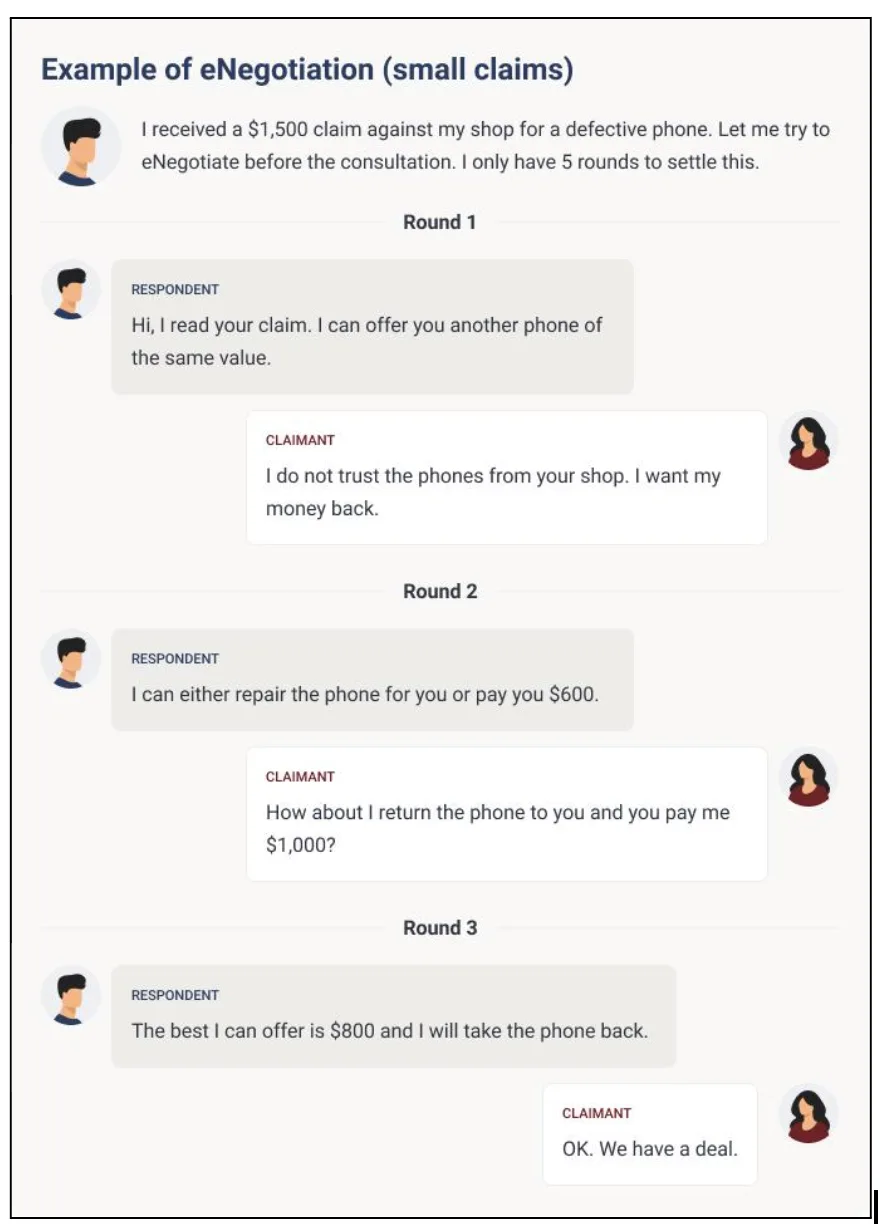
Example of Negotiation – Courtesy of the Singapore Courts (Source)
- To commence e-negotiations, the Respondent will have to log into CJTS and click on the e-negotiate link for the case in question under the “Active Cases” section. The Respondent is to follow the instructions on CJTS to fill up the required information.
- Under the e-negotiation form, the Respondent may choose to (1) agree to the amount claimed, (2) disagree with the claim, and propose an alternative amount or payment arrangement to that claimed by the Claimant, or (3) disagree with the claim, and not provide any alternative proposal.
- To respond, the Claimant is to click on e-negotiate link for the case in question under the “Active Cases” section.
- Having seen the Respondent’s proposal (if any), the Claimant may choose to (1) agree to the proposal, (2) disagree to the proposal, and propose an alternative amount claimed or payment arrangement, or (3) disagree with the proposal, and not make any counter-proposal.
- “in eNegotiation CJTS”: https://www.judiciary.gov.sg/docs/default-source/civil-docs/cjts_guide_filing_enegotiation.pdf?sfvrsn=49412f9e_2
- “Filing a Small Claim In CJTS – A Guide to Filing Small Claims Online”: https://www.judiciary.gov.sg/docs/default-source/civil-docs/cjts_guide_filing_small_claims_online.pdf?sfvrsn=981f1
E-Mediations
Where Parties fail to reach a settlement through e-negotiation, either Party may request for e-mediation. Under e-mediation, the parties will resolve their dispute online with the help of a court-appointed mediator, without having to go to Court.- To request for e-mediation, either party may select the “Request for eMediation” option under the eNegotiation page on CJTS.
- After a request is submitted, the other party will be notified, and the court will process the request.
- E-mediation will only proceed if all Parties are agreeable to it, and the court will contact the parties to schedule a date and time. If any Party does not agree to e-Mediation, it will not proceed.
Outcomes of E-Negotiations or E-Mediations
Where no settlement agreement is reached between the Parties after both e-negotiation and e-mediation, they will be required to attend the next schedule consultation or hearing at the SCT. However, if a settlement agreement is reached between the Parties, whether via e-negotiation or e-mediation, the Parties may opt to either (1) have the settlement agreement recorded as a consent order, or (2) have the Claimant withdraw the claim.- Application for Consent Order: A consent order officially records the terms of the Parties settlement, allowing it to be enforced as an order of the SCT. As such, Parties must comply with the terms of the consent order, which also cannot be appealed against by the parties.
- E-negotiation: For settlements reached through e-negotiation, either Party may make this application through CJTS, by selecting the “Apply for Order of Tribunal” option on the e-negotiation acknowledgement page.
- E-mediation: For settlements reached through e-mediation, such an application will be facilitated by the court-appointed mediator.
- Withdrawal of Claim: The Claimant may alternatively choose to withdraw their claim through CJTS, by selecting the Withdrawal Request Form under the “Online Applications” tab. Where the claimant’s application is approved, the claim will be withdrawn, and the Parties will be notified as such. Accordingly, there will be no further proceedings, and the Parties need not attend any more consultations or hearings. However, if the request for withdrawal is rejected, the Parties will be duly informed and will have to attend the next scheduled consultation or hearing.
Resolving the Dispute at the SCT
Where the Parties are unable, refuse or fail to resolve the dispute online via e-mediation and e-negotiation, the claim will then be heard in the SCT. It will be dealt on first instance by the Registrar at a consultation, and if unsuccessful, subsequently at a hearing before the Tribunal Magistrate.General Points to Note
Before going for any consultation or hearing before the SCT, the following points must be noted.- Preparation for Consultation/Hearing:
- First and foremost, the Parties should prepare to explain their case at the consultation or hearing. Every part of the Parties’ claim or defence should be explained in detail – for example, the Claimant must be able explain every invoice and defect raised in a claim for the sale of defective goods.
- Additionally, if the claim proceeds to a hearing, the Parties may also wish to call for witnesses to give evidence on the relevant facts. Here, Parties should (1) contact witnesses in advance to ensure their willingness to attend the hearing, (2) inform the Registrar of their intention to call for witnesses during the consultation, and (3) inform the Tribunal Magistrate that they have called for witnesses during the hearing, so that Tribunal Magistrate may decide whether to allow the witnesses to give evidence. It should be noted that if the Parties’ witnesses are reluctant to attend the hearing, the Parties may file a Summons to Witness via CJTS to compel their attendance. This is to be filed at least 3 days before the scheduled date of hearing, and is subject to the SCT’s approval. A step-by-step guide for how to file a Summons to Witness may be found and accessed at https://www.judiciary.gov.sg/docs/default-source/civil-docs/cjts_guide_filing_small_claims_online.pdf?sfvrsn=981f1aa0_2.
- Furthermore, it should be noted that SCT proceedings are conducted in the English language. Should any Party, or their witnesses, be uncomfortable communicating in English, the SCT allows for interpretative services to be arranged, as set out in the table below.
Parties also have the option of applying for a family member, friend, or volunteer to attend the consultation or hearing to assist with interpretation, via the Community Courts and Tribunals Friend Scheme. For more details on how to make this application, please visit https://www.judiciary.gov.sg/legal-help-support/cct-friend-scheme.Languages How to arrange interpretative services Tamil, Malay, Mandarin, Hokkien, and other local Chinese dialects. The SCT provides free interpretation services for these languages. Parties may express their intention of using this service by indicating their preferred language via CJTS, or during a consultation with the Registrar. Other languages Parties are to arrange and pay for their own interpretation services.
Procedure in Consultations with Registrar
As previously mentioned, claims that reach the SCT will be dealt with by the Registrar in a consultation on first instance. A consultation is a proceeding in the SCT before any hearing, where the Registrar will facilitate a discussion between both parties. The aim is to resolve the dispute amicably without moving on to a hearing.
Parties will be notified of the date, time and venue of their scheduled consultation through CJTS, and will receive a reminder to attend via email 3 days prior to, and by SMS 1 day before the date of the consultation. On the day of the consultation, Parties may proceed to Level 3 of the State Courts and take a queue number for consultation. When the Parties queue number is called, they may proceed to the Registrar’s chambers to commence the consultation.
If the Parties successfully reach a settlement during the consultation, the Registrar may record a consent order to reflect the Parties’ agreement. This consent order will then be provided to the Parties by the Registrar, or via CJTS.
However, if Parties fail to reach a settlement, the Registrar will provide further directions on how to proceed with the claim. This may include:
- Arranging for further consultations.
- Directing the Parties to seek mediation at a Community Mediation Centre, with or without the consent of the Parties.
- Arranging for a hearing before a Tribunal Magistrate, which can occur within 24 hours of the consultation.
Procedure in Hearings before Tribunal Magistrate
Where a claim is not settled in a consultation, it will proceed to a hearing before a Tribunal Magistrate. Parties will be notified of the date, time and venue of their scheduled hearing through CJTS, and will receive a reminder to attend via email 3 days prior to, and by SMS 1 day before the date of the hearing.
Where a claim is not settled in a consultation, it will proceed to a hearing before a Tribunal Magistrate. Parties will be notified of the date, time and venue of their scheduled hearing through CJTS, and will receive a reminder to attend via email 3 days prior to, and by SMS 1 day before the date of the hearing.
Prior to the scheduled hearing, Parties may take the optional step of uploading their submissions (i.e. their case), to allow the Tribunal Magistrate toe to review them in advance.
This would involve a Party preparing and submitting a chronological list of events which they deem relevant in helping them present a clear and coherent case.
- Submissions are to be filed on CJTS, and a detailed guide of doing so may be accessed at https://www.judiciary.gov.sg/docs/default-source/civil-docs/cjts_guide_filing_small_claims_online.pdf?sfvrsn=981f1aa0_2.
- It should be noted that if both Parties file their submissions prior to the hearing, they will both be able to see each other’s submissions on CJTS. However, if only 1 Party files their submissions, it will not be available to the other non-filing Party.
On the day of the hearing, Parties are to proceed to Level 3 of the State Courts and take a queue number for hearing. Once their queue number is called, the Parties may proceed into the Tribunal Magistrate’s hearing room to being the hearing.
- The hearing will be conducted in the private and informal manner.
- Each Party will take turns to present their case and supporting evidence. The Tribunal Magistrate will direct the flow and manner of the hearing, and will direct the Parties to answer certain questions or address relevant issues.
- At the end of the hearing, the Tribunal Magistrate will make a decision based on the merits of the Parties case, and in accordance with the law. The possible orders and decisions that the Tribunal Magistrate may make has been set out in a previous section of this article. In some cases, the Tribunal Magistrate may call for further hearing dates if the dispute cannot be resolved in that hearing, or postpone the judgment to a later date.
What Are The Post-Dispute Actions After An SCT Decision?
Having received a decision from the SCT at either a consultation or hearing, the Parties take the following actions in relation to such decisions.
Enforcement of SCT Orders
Where the SCT has made an order in a Party’s favour (the “Enforcement Applicant”), and the other Party does not comply with that order (the “Enforcement Respondent”), the Enforcement Applicant may apply to enforce the SCT order.
As a preliminary point, since enforcement proceedings take place in the civil courts and not the SCT, the Enforcement Applicant will be allowed to engage a lawyer. Due to the more complex considerations and processes involved in enforcement proceedings, it would be prudent for an Enforcement Applicant to seek legal advice prior to commencing enforcement proceedings.
Consideration prior to Enforcement
It should be noted that enforcing an SCT order does not guarantee the Enforcement Applicant’s desired outcomes, and one should always weigh the pros and cons of doing so before proceeding. Some relevant considerations would include:
- Is it worthwhile to pursue enforcement of the order? The Enforcement Applicant will have to spend time and effort to make the necessary applications to enforce the order, and once again, there is no guarantee that they will be able to recover anything from the Enforcement Respondent.
- Whether the Enforcement Applicant is willing to pay the fees for enforcement? Generally, fees paid in enforcement proceedings are non-refundable should the enforcement proceedings not be successful. The Enforcement Applicant should therefore consider if they are willing and able to let go of those fees should their application to enforce fail.
- Whether the Enforcement Respondent is able to pay the Enforcement Applicant? If the Enforcement Respondent is involved in any bankruptcy, winding up, receivership or judicial management proceedings, this may affect their ability to pay the Enforcement Applicant in any enforcement proceedings. Such information is accessible at the LawNet and CrimsonLogic Service Bureau, and if the Enforcement Respondent is involved in such proceedings, the Enforcement Applicant should seek legal advice on the available courses of action.
Process of Seeking Enforcement
SCT orders may be enforced in the same manner as a judgement or an order made by the District Court. Here, the Enforcement Applicant is to take out a single enforcement application using the prescribed form, accessible at https://github.com/opendocsg/opendoc-state-courts-practice-directions-2021/raw/master/Forms/Appendix%20A2/Form%2038.pdf.
This prescribed form may only be filed 3 days after the SCT order has been served on the Enforcement Respondent, and must be accompanied by an affidavit containing the following details:
- The exact terms of the SCT order.
- The Enforcement Respondent’s full name and address.
- The date the SCT order was served on the Enforcement Respondent.
- Which parts of the SCT order have not been complied with and are now being enforced.
- If more than 6 years have passed since the SCT order was made, the reasons for the delay in applying.
- Any changes to the identity of either party (applicant or respondent) since the order was made.
- If the order involves payment of money: (1) the total amount due, (2) any amount recovered from security, (3) any amount already paid, and (4) the outstanding balance.
- If interest is still accruing, the daily interest amount owed from the date of making of the affidavit.
- If specific property (not already listed in the Court order) is to be seized: (1) a description of the property, and (2) evidence that it is owned, possessed or controlled by the Enforcement Respondent.
- If that specific property is not in the respondent’s possession or control, evidence that everyone currently in control of it has been notified of the application.
- If money held by a third party or a debt owed to the respondent is to be attached: (1) a description of the deposit or debt, and (2) evidence that it belongs to or is payable to the Enforcement Respondent (now or in future).
- Whether the Sheriff should enforce different parts of the enforcement order in a specific order, or whether some or all parts may be enforced at the same time.
- An undertaking by the enforcement applicant or their solicitors, confirming that they will:
- indemnify the Sheriff against all claims, costs and expenses arising from carrying out the order;
- pay all Sheriff’s charges, fees, commissions and expenses when requested; and
- deposit any sum requested by the Sheriff before and during enforcement,
- A written undertaking setting out all of the points stated above.
There will be fees attached to the making of a single enforcement application, and the table of estimated fees may be found at https://www.judiciary.gov.sg/civil/single-enforcement-application.
As can be seen, preparing and filing a single enforcement application is an intricate and complicated process, as such it is recommended that the Enforcement Applicant engages a lawyer to assist with the application.
Examination of Enforcement Respondent
Before enforcing an SCT order, the Enforcement Applicant may first wish to determine what assets the Enforcement Respondent has that could be used to satisfy the debt owed under the order. This can be done by applying to examine the Enforcement Respondent under oath. Doing so enables the Enforcement Applicant to make an informed decision on the most appropriate enforcement method, with a full understanding of the nature and extent of the Enforcement Respondent’s assets.
An application to examine the Enforcement Respondent may be made in the following prescribed form:
https://github.com/opendocsg/opendoc-state-courts-practice-directions-2021/raw/master/Forms/Appendix%20A2/Form%2041.pdf. A detailed guide on the procedures in filing such an application as well as the process of conducting such an examination is available at https://www.judiciary.gov.sg/civil/civil-claims-(from-1-april-2022)/enforce-an-order-or-judgment-(from-1-april-2022)/examination-of-enforcement-respondent-(from-1-april-2022)/file-an-order-for-examination-of-enforcement-respondent-(from-1-april-2022).
For details on how to respond to an Order for Examination of Enforcement Respondent, please refer to the comprehensive guide issued by the Singapore Courts:
Types of Enforcement Orders
In enforcement proceedings, the Enforcement Applicant may choose one or more of the following orders to be enforced, which will be carried by the Sheriff.
- Enforcement Order for Seizure and Sale of Property: This is an order to seize and sell property belonging to the Enforcement Respondent.
- Enforcement Order for Delivery or Possession of Property: This is an order to seize and deliver possession of property in the possession or control of the Enforcement Respondent.
- Enforcement Order for Attachment of a Debt (Garnishee Order): This is an order to attach a debt which is due to the enforcement respondent from any third-party, whether immediately, at some future date, or at certain intervals in the future. In gist, it allows money owed to the Enforcement Respondent by a third party to be taken to satisfy the judgment. An examples of such debt would money deposited by the Enforcement Respondent in a third-party financial institution.
- Enforcement Order to do Anything Specified in SCT Order: This is a general order to execute the directions set out in the SCT order.
An enforcement order is valid for 12 months from the date of its issuance, and may be extended by another 12 months by an application to the Courts before the date it is originally due to expire. An enforcement order also ceases to be valid if:
- the parties confirm that the SCT judgment has been satisfied by filing a written consent from the Enforcement Applicant, or
- the enforcement applicant informs the Sheriff in writing to stop enforcement because the enforcement respondent has complied with the court order, or for some other reason.
Setting Aside Default Orders
As previously covered in this article, where a Party is absent from a scheduled consultation or hearing without reasonable excuse, the SCT may issue a default order against the absent Party (the “Affected Party”). Here, the Affected Party has the option to apply to set aside the default order within 1 month of the date of the default order. The application is to be filed via CJTS, and must include the Affected Party’s claim number, default order number, reason for making application, and any supporting documents in PDF format. For detailed instructions on how to file such an application, please refer to the guide published by the State Courts, available at:
https://www.judiciary.gov.sg/docs/default-source/civil-docs/cjts_guide_filing_small_claims_online.pdf?sfvrsn=981f1aa0_2.After an application to set aside a default order has been filed, the Parties will be informed of the date, time and venue of the hearing of the application through CJTS. The Affected Party is to bring all evidence used in support of their application to the hearing. In the hearing, the presiding Registrar or Tribunal Magistrate will if the application should be allowed or dismissed.
- If the application is allowed, the case will proceed with another consultation or hearing, depending on which stage of the SCT dispute resolution process it is at.
- If the application is dismissed, the default order will continue to stand.
Here, the Affected Party is reminded that their attendance at this hearing is compulsory, and if they are absent without reasonable excuse again, their application will be dismissed and they may be barred from making further applications to set aside the default order.
Appealing of SCT Orders
Generally, SCT orders are final and binding on the Parties , and a dissatisfied Party may only appeal against decisions of the SCT under very specific circumstances and the appeals from SCT orders are limited to questions of law or jurisdictional errors. Generally, appeals may be filed at 2 stages in the SCT dispute resolution process, as set out below.
Appeal after Consultation with Registrar
At a consultation, a discontinuance order may be issued where the Registrar is of the opinion that a claim or counterclaim is outside of the SCT’s jurisdictions. Here, the Party affected the discontinuance order may appeal that decision within 1 month of the Registrar’s making that order.
Such an appeal may be filed via CJTS, and appealing Party (the “Appellant”) will have to provide their claim number, discontinuance order number, reasons for appeal, and any supporting documents in PDF format. The Appellant will also have pay a filing fee of S$20, and serve a notice of appeal on the other party (the “Respondent) within 7 days of the date of filing of the appeal. For a detailed guide on how to appeal against the discontinuance order of the Registrar, please refer to the following instructions: https://www.judiciary.gov.sg/docs/default-source/civil-docs/cjts_guide_filing_small_claims_online.pdf?sfvrsn=981f1aa0_2.
After such an appeal has been filed, the Parties will be informed of the hearing date to decide on the appeal through CJTS. During the hearing, a Tribunal Magistrate will decide whether to allow or dismiss the appeal.
- If the appeal is dismissed, then the discontinuance order stands. As such, the claim can no longer proceed in the SCT, but may be pursued in other courts. Filing fees will also not be refunded to the Appellant.
- If the appeal is allowed, the Tribunal Magistrate may proceed to hear the Appellant’s claim, and make the appropriate order.
The Tribunal Magistrate’s decision to allow or dismiss an appeal against the Registrar’s discontinuance order is final, and may not be appealed against by the Parties. Additionally, it should be noted that if the Appellant fails to attend the hearing without reasonable excuse, their appeal will be dismissed.
Appeal after Hearing before Tribunal Magistrate
Parties may also appeal against SCT orders made by the Tribunal Magistrate. However, these may only be appealed on 2 grounds:
- Question of Law: An SCT order may be appealed against on the basis that there is question of law that needs to be addressed. This is an enquiry into the law applied in making the SCT order, and differs from a question of fact, which looks at the facts of a case. An example of a question of law would be whether the Consumer Protection (Fair Trading) Act applies if a product is not covered under warranty.
- Question of Jurisdiction: An SCT order may be appealed on the grounds that the SCT was outside its jurisdiction in making the order. For example, an SCT order may be appealed on the basis that the amount claimed exceeded the Prescribed Limit of SCT claims.
For the avoidance of doubt, an appeal cannot be based on a question relating to a finding of fact by the Tribunal Magistrate, and new evidence will not be allowed in an appeal.
Additionally, only certain orders of the Tribunal Magistrate may be appealed against, as set out in the table below:
| Appealable Orders | Non-appealable Orders |
|---|---|
|
1. Money orders 2. Work orders 3. Orders to vary a work order 4. Orders for vacant possession 5. Orders dismissing a claim 6. Ancillary orders made to give effect to any order of the SCT |
1. Discontinuance orders 2. Transfer orders 3. Default orders (these can be set aside, not appealed) 4. Consent orders. |
Such appeals will be heard by the General Division of the High Court (the “SGHC”), but only if permission to appeal is granted by the District Court.
- Filing Application for Permission to Appeal: The Appellant may file the application for permission to appeal on CJTS, and will be required to provide their claim number, SCT order number, grounds of appeal, and any supporting documents in PDF format. A filing fee of S$100 will be incurred by the Appellant. For more details on how to make such an application on CJTS, please refer to the guide published by the State Courts at https://www.judiciary.gov.sg/docs/default-source/civil-docs/cjts_guide_filing_small_claims_online.pdf?sfvrsn=981f1aa0_2.
- Deadlines and Timelines: The Appellant must file the application for permission to appeal within 14 days from the date the order being appealed against was made. Additionally, the Appellant will also be required to serve the application on the Respondent within 14 days of making the application. Here, the Respondent may file and serve on the Appellant a response within 14 days of being served the application, should they intend to oppose the Appellant’s application.
- Pre-Hearing/Case Management Conference: Following the filing of the application for permission to appeal, the Parties will be directed attend a pre-hearing conference (for matters commenced before 1 April 2022) or a case management conference (for matters commenced on or after 1 April 2022). The Parties will be informed of the date and venue of the conference via CJTS.
At the conference, a Registrar will brief the Parties on the administrative details of the application before scheduling a hearing with a district judge. Additionally, the Registrar may also issue such orders or directions as they think fit, so as to deal with the application in a just, efficient and economical manner.
- Hearing of Application by District Judge: Where the Registrar arranges a hearing during the pre-hearing/case management conference, the Parties will be required to attend the hearing of the application for permission to appeal. During the hearing, a district judge will decide whether to allow or dismiss the application. Additionally, where the appeal does not involve a question of law or jurisdiction, the district judge may also order that the matter be reheard by the SCT. Here, the district judge’s decision is final, and may not be appealed against by the Parties.
Where permission to appeal is granted by the District Court, the Appellant may then proceed to bring the appeal to the SGHC.
- Filing and Serving Notice of Appeal: This process is commenced by filing a Notice of Appeal on CJTS, within 1 month of the permission to appeal being granted by the District Court. Here, the Appellant will incur a filing fee of S$600. The Notice of Appeal must state the details of the SCT order complained of, and contain an address for service. Additionally, the Appellant must serve the Notice of Appeal on the Respondent within 7 days of the date that it is filed.
- Record of Proceedings: After the Notice of Appeal is filed, the SCT will prepare the Record of Proceedings relating to the Appellant’s claim, which will include:
- A certified copy of the grounds of the SCT order appealed.
- A certified copy of the notes taken by the Tribunal Magistrate during the SCT hearing.
The Record of Proceedings will be sent to the Appellant via CJTS. It would be prudent for the Appellant to review it carefully and consider if they wish to proceed with the appeal. Legal advice at this stage is highly recommended.
- File Appellant’s Case and Provide Security of Costs:
- Should the Appellant intend to proceed with their appeal, they are to (1) file the Appellant’s Case in the appropriate form, and (2) serve a copy of the Appellant’s Case on the Respondent, within 21 days of receiving the Record of Proceedings. The Appellant’s Case is to be filed on CJTS, and is to be served via personal delivery or registered post to the Respondent. If the Appellant’s Case is not filed and served by the aforementioned deadline, the Appellant’s appeal is taken to be withdrawn.
At the time of filing the Appellant’s Case, the Appellant will also be required to deposit S$500 to the Accountant-General’s Department as security for the Respondent’s costs of appeal. To make this deposit, the Appellant is to submit an application through CJTS, and the SCT will then provide the Appellant with further instructions on how to deposit the security of costs. It should be noted that the SGHC may, if it thinks fit, order the Appellant to make further deposits as security for costs.
After the Appellant has provided the security for costs, they are to obtain a certificate to indicate that they had made the requisite deposit from the Accountant General.
- Submission of Respondent’s Case: Should the Respondent wish to contest the appeal, the Respondent must (1) file the Respondent’s Case in the appropriate form, and (2) serve a copy of the Respondent’s case on the Appellant, within 14 days of the date of service the Appellant’s Case.
- Attend Hearing for Appeal: Upon the completion of the above steps, the SCT will send the documents related to the Appellant’s case to the SGHC, which will then inform the parties of the date, time and venue of the hearing for the appeal via post. The outcome of the appeal will depend on the decision made by the SGHC at the hearing, as summarise in the table below:
| SGHC’s Decision | Implications |
|---|---|
|
Allow the appeal |
The SGHC may order set aside or vary the SCT order being appealed. |
|
Dismiss the appeal |
There will be no changes to the original decision and order of the SCT. |
|
Order for another hearing |
The Appellant’s case may be sent back to the same tribunal for reconsideration or to another tribunal for a rehearing |
Here, the decision of the SGHC is final, and is not subject to further appeal by the Parties.
For a step-by-step guide on how to navigate the CJTS platform at each step, please refer to the State Court’s comprehensive publication: https://www.judiciary.gov.sg/docs/default-source/civil-docs/cjts_guide_filing_small_claims_online.pdf?sfvrsn=981f1aa0_2.
Conclusion
In conclusion, the SCT provides a practical and affordable avenue for resolving lower-value disputes without the complexity of formal court proceedings. As this article has outlined, Parties must ensure that their claim falls within the SCT’s jurisdiction before filing. Understanding the filing process, possible outcomes, types of orders available, and enforcement mechanisms is equally important in deciding whether the SCT is the most effective forum for resolving the dispute. With proper preparation, clear documentation, and realistic expectations of the remedies available, claimants can make full and efficient use of the SCT to achieve timely resolution of their matters.Disclaimer
This article is intended for general informational purposes only and does not constitute legal advice. While every effort has been made to ensure the accuracy and relevance of the information provided, readers are encouraged to consult a qualified legal professional for advice tailored to their specific circumstances. The content reflects the legal position in Singapore as of the time of writing and may be subject to changes in legislation or legal interpretation.